The Colombian truth commission, established as a result of the 2016 peace agreement between the Colombian government and the Revolutionary Armed Forces of Colombia (FARC), worked in 24 countries outside Colombia, seeking to understand why and how more than a million people left the country to safeguard their lives, the impact of this departure, and how these people coped with it. It was the first in the world to carry out systematic work on exile, taking testimonies of exiled people and involving them in all aspects of its mandate. In implementing this extraterritorial approach, the commission (CEV) built an innovative support network, made up of exiled Colombians, members of organizations supporting these people, academic institutions and other actors. This network relied on the work of more than a hundred volunteers and a few paid ‘liaison officers’, who joined efforts to disseminate the commission’s mandate and interview over 2,000 ‘victims’ abroad. In its final report, published in June 2022, the CEV dedicated an entire volume to exile and recognized it as a human rights violation. This project chronicles the innovative nature of the CEV that enabled it to carry out its work outside of Colombia in an attempt to generate a better understanding of transnational networked transitional justice to achieve a comprehensive historical truth that includes the ‘victims’ forced to flee abroad, as a significant contribution to transitional justice.
Funded by a grant from FLACSO Ecuador and support from UMass Boston and the Council on Foreign Relations, the project is led by co-PIs Cecile Mouly (FLACSO Ecuador) and Jeffrey Pugh (UMass Boston). The centerpiece edited book was co-edited by Mouly, Pugh, and Josefina Echavarria of the University of Notre Dame.
The research team, which were active participants in the support nodes of the Colombian Truth Commission's work with exile, have conducted dozens of interviews with past participants in the network, as well as commissioners and members of the Truth Commission staff in Bogota. They have presented in various international conferences and fora on the preliminary results of this work, and have multiple publications in progress. Feel free to follow this page for updates and outputs from the project.
Team Publications:
Cecile Mouly, Jeffrey D. Pugh and Josefina Echavarría Álvarez, eds. (2026). Cruzando fronteras en búsqueda de la verdad: el trabajo de la Comisión de Verdad de Colombia con el exilio (Editorial Universidad del Externado, Colombia, in press)
Presentations and data:
Crossing Borders in Search of the Truth: The Work of the Colombia Truth Commission with Exiles, Conflict Resolution Virtual Colloquium featuring Cecile Mouly, Jeff Pugh & Josefina Echavarría, co-sponsored by the University of Massachusetts Boston and FLACSO Ecuador
Legacy Project Lecture at the University of Notre Dame featuring Cécile Mouly: “A Network Analysis of the Work of the Colombian Truth Commission on Exile” (March 7, 2024)
Project team:
co-PIs: Cecile Mouly, Jeffrey Pugh
co-editors: Mouly, Pugh, and Josefina Echavarria
Graduate researchers: Daniela Chango, Kevin Ramirez, Pryanka Peñafiel Cevallos, Matteo Totime
Multimedia and Dissemination:
Trailer for the documentary Solo la Verdá, which focuses on the work of the Colombian Truth Commission with exiles in Ecuador
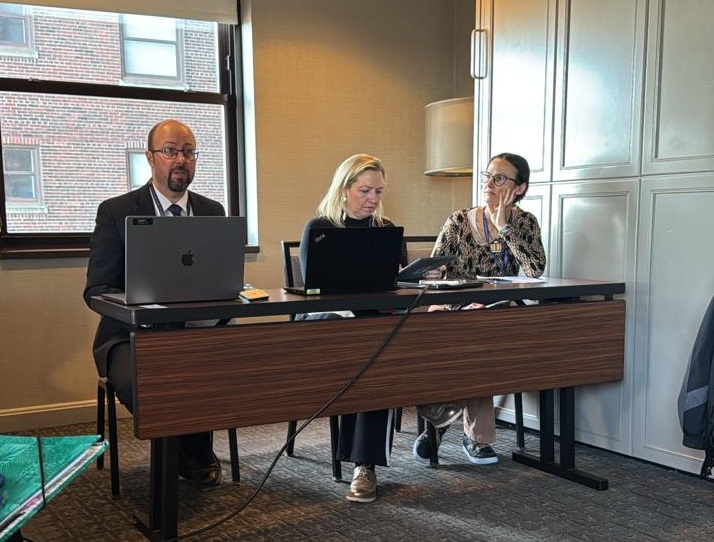
Editors presenting the work at ISA:
Related Publications:
Mouly, Cécile y Carmen Gómez Martín. 2023. "La «Colombia fuera de Colombia»: inclusión y participación de las personas exiliadas en la Comisión de la Verdad de Colombia. En Balances y perspectivas del cumplimiento del Acuerdo de Paz en Colombia (2016-2022), editado por Alexander Ugalde Zubiri e Iratxe Perea Ozerin, 337-360. Bilbao: Universidad del País Vasco / Euskal Herriko Unibertsitatea.
Gomez Martin, Carmen, Cecile Mouly, y Vanessa Paredes, eds. 2023. Movimientos migratorios Sur-Sur : fronteras, trayectorias y desigualdades no. 8: iniciativas desde el exilio para el mantenimiento del legado de la Comisión de la verdad de Colombia. 1a ed. - Ciudad Autónoma de Buenos Aires: CLACSO.
Martin Beristain, Carlos. 2023. “La experiencia de la Comisión de la Verdad en la escucha del exilio colombiano. Aprendizajes para la incorporación de la población refugiada en los procesos de justicia transicional y comisiones de la verdad.” Middle Atlantic Review of Latin American Studies, 7, no 2: 17-47. https://doi.org/10.23870/marlas.445
Pugh, Jeffrey. 2019. "Eroding Barriers between Peace and Justice: Transitional Justice Pathways and Sustainable Peace." International Journal of Peace Studies 24, No 1. Summer: 1-23. https://commons.lib.jmu.edu/ijps/vol24/iss1/3/
Prada Ramírez, M., & Murphy, E. (2026). Guide to Agonistic Pedagogy: A tool for a transitional justice. Kroc Institute for International Peace Studies. https://doi.org/10.7274/31100923
Kobayashi Rossi, M. E. (2026). Healing wounds, (co)creating legacies: The importance of art in the work of the Colombian Truth Commission (Version 1). University of Notre Dame. https://doi.org/10.7274/31078981.v1
Prada Ramírez, M “What Makes International Partnerships Meaningful in Transitional Processes? The Case of the Colombian Truth Commission (2018-2022).” Kroc Institute for International Peace Studies (July 2025).
Prada Ramírez, M., & Murphy, E. (2025). The Right to Peace and the Right to Stay: Insights From Approaches to Peace and Migration in Colombia. Journal on Migration and Human Security, 13(1), 45-55. https://doi.org/10.1177/23315024241309721